Lighthouse
The Passage (Justin Cronin Edition)The Lighthouse is the First Colony’s combined power-and-communications hub, where Michael Fisher’s work to keep the settlement illuminated becomes inseparable from listening for signals beyond its walls. Its control panels, old logbooks, radio equipment, and failing batteries make it both indispensable infrastructure and a point of vulnerability: a place where the Colony’s enforced silence is breached, and where years later the lights’ return reveals that someone has been drawing power elsewhere.
A working station in an isolated settlement
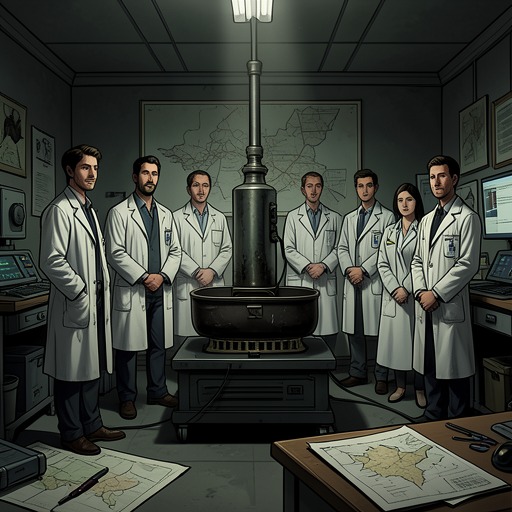
The Lighthouse serves as a practical workplace as well as a communications post. Michael, First Engineer of Light and Power, sits at its panel among CRT displays, meters, and equipment stored in bins; the station’s tasks range from monitoring the Colony’s electrical supply to interpreting radio traffic. The broader power system depends on wind turbines and batteries, a chain with a crucial weak link. The turbines can keep turning in the breeze, but the batteries must store and regulate their current. After nearly a century, their continued function is already extraordinary, and their decay threatens the Colony with a sudden loss of power on a windless night.
The station’s history is also shaped by a decision to suppress communication. In the Colony’s early years, a radio signal led the Walkers to the settlement, an outcome the Builders had not anticipated. The Colony was not expected to survive as long as it did; once its survival stretched on, the radio was ordered destroyed, the mountain antenna dismantled, and its components chopped up and scattered in the dump. The ban was therefore more than a rule about equipment: it was an effort to control the Colony’s exposure to the outside world. The Lighthouse remains the place where the prohibited technology and the knowledge needed to use it can still matter.
Michael’s watch and the returning signal
At the Lighthouse, Michael’s attention is captured by a faint digital transmission on 1,432 megahertz. It comes in a repeating string, initially seeming intermittent and elusive. He and Elton work out its exact rhythm: the signal returns every ninety minutes, transmits for 242 seconds, then falls silent. It grows stronger from cycle to cycle, especially at night, seeming to move straight up the mountain. Michael stops searching for other explanations and waits at the panel for its next appearance.
The work draws the station’s records and equipment into the search. Michael finds that the frequency is 1,432 megahertz, then turns to the harder problem of identifying the signal’s handshake: the reply that will persuade its transmitter to connect to the Lighthouse mainframe, after which the data can be uploaded. He plans to use an old Army handheld radio and lithium cells that can hold a charge for only a few minutes. At the next ninety-minute interval, he intends to connect the handheld to the computer, capture the signal’s embedded ID, and program a response from the panel. His attention is so fixed on this technical task that he only dimly registers commotion outside.
The Lighthouse is not only a room of machinery but also a place where private exchanges unfold alongside the work. Sara enters at half-night to find Elton asleep at the panel with earphones clamped to his head. She brings him something, and he offers her the earphones and, in return, a small present intended to cheer her. In another scene, he searches the counter by touch before handing them over. Such moments give the station a human scale: its equipment is handled, borrowed, and shared by people whose lives continue amid the demands of the watch.
Records, devices, and the girl’s transmitter
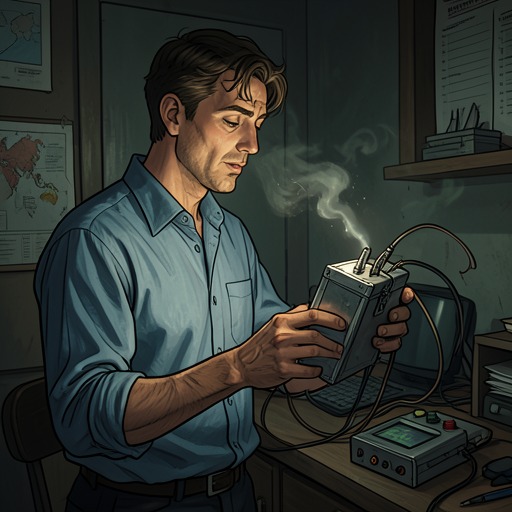
The Lighthouse’s old records become important when the Colony investigates a device removed from the girl’s neck. Michael examines it in pieces on a leather mat beside his CRT. He identifies a memory chip connected to the transmitter, unusually small and lacking ordinary ports except for two tiny gold brads. One brad links to the transmitter; the other connects to a filigree of beaded wires. He considers whether the wires form an antenna array or act as sensors that supply data for the chip to record. The device’s construction is unfamiliar, but the station gives him a place to inspect it and relate it to the Colony’s accumulated technical knowledge.
A hunch sends Michael back through the old logbook. He discovers that the Lighthouse received a beacon from the same coordinates eighty years earlier, on an old-style military distress frequency using Morse code. The logbook turns an apparent new signal into a recurrence with a buried history. The station’s records do not immediately explain what the signal means, but they establish that the coordinates have called to the Colony before, linking present investigation to a transmission from an earlier generation.
Michael’s habits make the Lighthouse feel almost continuous with his waking mind. He treats sleep as wasted time; even his remembered dreams resemble his daytime work, filled with circuits, breakers, relays, and unsolved problems. When the lights go out, he returns to his terminal and finds the device from the girl’s neck laid beside the CRT. The station gathers these different forms of information in one space: electrical diagnostics, radio signals, old entries in the logbook, and the strange data-bearing object now under examination.
Power, silence, and the final illumination
The Lighthouse’s role becomes especially stark when Michael confronts the decay of the Colony’s batteries. He watches their condition on the green bars of an old, battle-hardened CRT and understands that they are failing badly. Their survival after decades is a miracle, not a guarantee. The Colony can have turning turbines and still face darkness if the batteries can no longer hold and regulate their output; power depends on maintenance and storage as much as on generation.
Much later, the travelers approach a vast field of wind-driven blades and move toward the power station. They find its fence open. At the hatch, Michael removes the plate covering the mechanism and turns the tumblers manually with the end of his blade. Below, a lantern reveals a room in disarray: the long central table has been overturned as though used for defense, and cartridges and spent magazines litter the floor. Yet the control panel remains intact, its meters glowing with current. The contrast between damage in the rooms and power still registering at the panel makes the station’s apparent abandonment uncertain rather than complete.
Michael reads the system backup log and finds a record of automated requests for more current whenever the batteries fall below forty percent. The system had first made such a request six years earlier and then almost every night, until 323 cycles before his examination. The absence of recent requests leaves two explanations: someone repaired the batteries, which Michael considers highly unlikely, or someone stopped drawing current. He concludes that somebody turned the lights off.
The ending makes that diagnosis visible. The group closes the gate and gathers in the Sunspot, while Michael returns to the Lighthouse. At twilight, the settlement seems suspended in silence. Then the lights come on with an audible pop, flooding the group with fierce brilliance. The Lighthouse’s power system thus becomes more than background machinery: its readings expose an unseen change in the settlement’s use of energy, and its restoration turns a technical question into a renewed sign of connection and possibility.